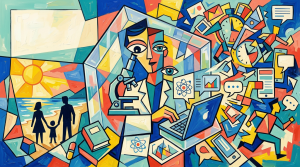
This topic has made me reflect on the difference between participating online and exposing myself online. I understand that digital spaces are important for learning, collaboration, access to information, and professional communication. As an educator and scientist, I can see their value clearly. Yet I do not feel that being digitally present requires making my personal life public.
I do not want to reveal my private life online. My family, my relationships and my most personal experiences are not material for public consumption. This is not because I reject communication or connection, but because I believe privacy has value. Not everything meaningful needs to be displayed, documented or turned into content. Some parts of life become more valuable precisely because they are protected from constant visibility.
Professionally, I want to use online spaces to communicate science, share ideas, collaborate and support learning. I can speak about developmental biology, microscopy, research questions, education and the intellectual curiosity that drives my work. However, I want to be careful when expressing personal opinions on political, ethical or social issues through professional channels. These topics matter, but they are often complex, emotionally charged and easily simplified online. A quick post may invite immediate reactions rather than thoughtful dialogue, especially when it is detached from context.
I do not feel overwhelmed by online courses or digital environments themselves. In fact, many of the ideas presented in courses about digital literacy—critical thinking, ethical behaviour, responsibility, respect for others and careful communication—seem like common sense. Sometimes I feel that, if people were more pragmatic and acted more ethically, many of these courses would not be necessary. Yet perhaps the need to teach these principles shows that common sense is not always common practice.
This brings me to a deeper concern about the speed of online culture. I often feel there is a gap between my generation and some of my younger students. Many seem to struggle with waiting, reflecting and critically examining what is around them. There is a tendency to react immediately rather than act deliberately; to respond before thinking; to express an opinion before understanding the question. This can make online spaces feel intellectually shallow, even when they are full of information.
For me, digital literacy should therefore include the ability to pause. It should mean learning to distinguish information from knowledge, reaction from reflection and visibility from participation. It should also involve accepting that not every issue needs an instant answer. Sometimes the most responsible contribution is to listen, read carefully, think deeply and wait.
This perspective is close to an idea often associated with the Buddha, which I try to practice every day: that we should aim to become masters of ourselves, and that this requires looking inward. In a digital environment designed to capture attention and encourage constant reaction, self-mastery may mean resisting the pressure to comment, perform or expose oneself. It may mean choosing silence when silence is more honest than a quick opinion. Moreover, the digital space tends to encourage the tendency to perform, to suit others’ expectations of ourselves, not finding ourselves.
Because of this, I tend to feel shy about exposing myself online. I do not want to create a digital identity that is louder, simpler or more certain than I really am. I would rather be present in a measured way: contributing when I have something meaningful to offer, communicating professionally and respectfully, and keeping a clear boundary around what belongs to my private life.
My line is therefore not between being online and being offline. It is between purposeful participation and unnecessary exposure. I want to use digital spaces to learn, teach, collaborate, and communicate science, but without giving away the parts of myself that I believe should remain personal.
Looking back, I really cherish being born before the internet and digital connection existed. I realise, from where I stand now, that being able to grow in such times, where you had to wait for the time your favorite shows were on TV, or that you had to deal with boredom in a creative manner, which drove me to explore the natural world around me, science, friendships, books, and art, really gave me tools to find the silence to make me look inside at what those explorations and life experiences have done to me and continue to.
Mónica Fernandes October 12, 2026
I strongly agree with your point about the importance of being cautious when expressing personal opinions on complex or sensitive issues through professional channels. Online communication often lacks the context and nuance needed for meaningful discussion, and opinions can easily be misunderstood or taken out of context. I think this is particularly relevant for us as educators and scientists, as our professional identity may influence how our words are interpreted. Finding the right balance between authentic expression, professional responsibility, and thoughtful communication is indeed a challenge.