I have been creating and sharing open tools, teaching materials, and reproducible workflows for years. For me, openness is not a strategic choice. It is simply how I work. I put my teaching materials online, I use open-source tools, I contribute to open-source projects. This is an extension of who I am as a computational biologist and educator.
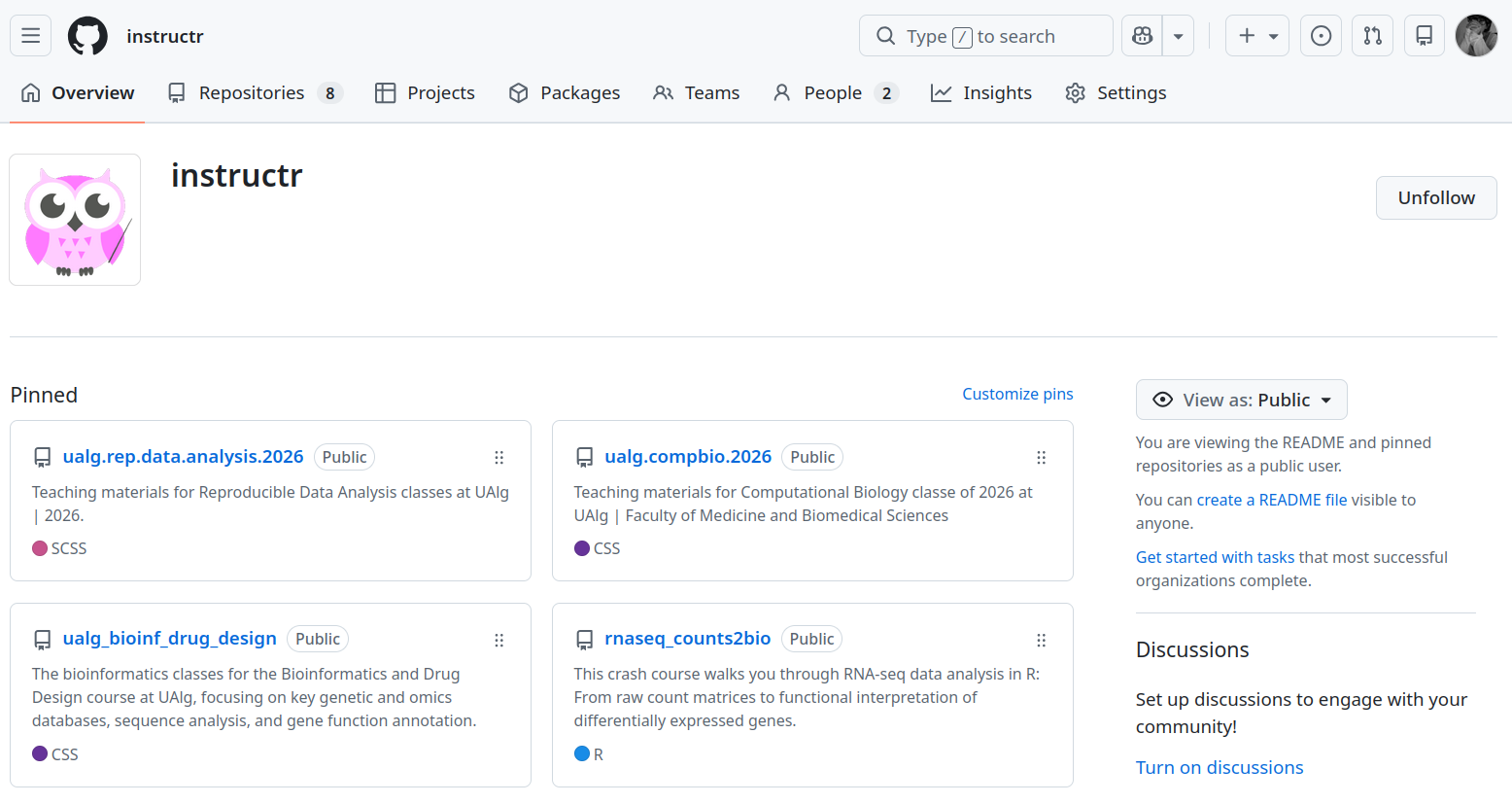
My GitHub account with my Open teaching materials [https://github.com/instructr].
So when my PBL group raised concerns about the risks of openness, about being taken advantage of, about others profiting from your work, about losing recognition, I found myself genuinely surprised. Not because these concerns are invalid (they are innate, natural, human), but because I had never framed openness in terms of what I might lose.
The Concerns
My colleagues articulated several worries that I feel many educators share:
- What if someone takes my materials and claims them as their own?
- What if a company profits from work I gave away freely?
- What if I never get credited for something I spent months creating?
- Is it not a form of “stealing” when someone uses open content without contributing back?
These are real anxieties, and I do not want to dismiss them. But I think they rest on assumptions worth examining.
A Different Framing
When I share my teaching materials openly, I am not giving something away. I am putting something into the world that did not exist before. The work is already done; the only question is how many people benefit from it.
If a colleague in Nairobi or in Rio de Janeiro uses my reproducible analysis tutorial to teach their students, I have not lost anything. My slides are still mine. My understanding is still mine. What has changed is that knowledge has travelled further than I could have carried it alone.
The fear of “inappropriate appropriation” assumes a zero-sum game: if someone else gains, I must have lost. But knowledge does not work that way. Teaching materials are not a finite resource that depletes when shared.
On Recognition
Will everyone who uses my materials cite me? No. Does that bother me? Honestly, not much.
Recognition is pleasant, but it is not why I teach. I teach because I want people to analyse data well, to think reproducibly, to build on solid foundations. If my materials help someone do that (even if they never know my name), the goal is achieved.
There is also a practical point: the people most likely to use and adapt open materials are often those with the fewest resources. Demanding formal recognition from every user would create barriers that defeat my purpose for sharing in the first place.
On Being “Taken Advantage Of“
This framing troubles me because it implies that generosity requires reciprocity to be valid. But I did not share my materials as part of a transaction. I shared them because I believe open science makes research better, and because hoarding knowledge feels contrary to what education should be.
If someone uses my work to build something I never imagined, even commercially, that is not theft. That is exactly what open licensing permits. The Creative Commons licence I choose is not a loophole being exploited; it is a deliberate invitation. Copyleft instead of copyright!
Could someone act in bad faith? Certainly. But designing my practice around the worst possible actor seems like a less joyful way to live.
The Real Risk
I would argue the greater risk is not openness but closure. When we keep our materials locked away: we duplicate effort across institutions; we slow the spread of good pedagogical ideas; we make teaching quality dependent on local resources; and we exclude those who cannot afford proprietary alternatives.
The cost of not sharing is invisible but real. It is measured in students who never encountered a clear explanation, in researchers who reinvented methods that already existed, in communities that remained disconnected from knowledge that could have helped them.
Open educational materials democratize access to knowledge. They contribute, however slightly, to making learning a bit more equitable.
Conclusion
I understand the fear of vulnerability that openness brings. Putting your work out there means accepting that you cannot control what happens to it. That feels uncomfortable.
But I keep returning to a simple question: What kind of academic culture do I want to help build? One where we guard our materials tightly, or one where we trust that most people will use shared knowledge in good faith?
I choose the latter. Not because I am naive about the risks, but because the alternative, a closed, suspicious, transactional approach to knowledge, seems far more costly in the end.
Isabel! Thank you for this fantastic reflection on this!
I’m in principle a supporter of open education, but in practice, neither a user nor a contributor. 🙁 (I excuse myself in part because I haven’t really had teaching that means I create resources beyond slides that introduce minimal points and then mark ‘discuss’, though I have a few sets of notes that arguably should be available more widely.) In my reading I came across an interesting – and disturbing – point in an article: sharing something as an OER requires that the initial uploader holds the copyright, but it’s not uncommon for university contracts to state that the university at which the teacher works is the copyright holder of teaching materials, not the teacher who creates them -> OER stopped dead (https://doi.org/10.5944/openpraxis.9.2.571). I think I might have come across this – or something very similar about research work/data – at one of the universities I’ve been at too, and it has contributed to my hesitancy to try to make resources available – I’m over half-convinced that I would be in contravention with university rules (for all that no one ever says anything when one arrives, and it’s likely no one will follow up, so one only gets some sort of an idea that this might be the case by careful reading of, e.g., ‘now you’re leaving’ information).