
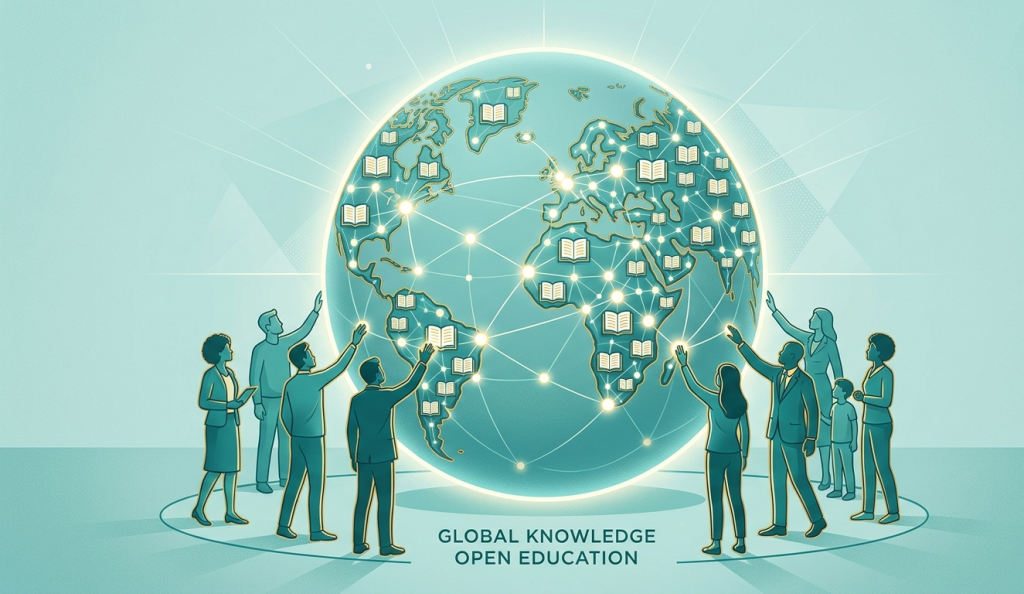
 These past 2 weeks our group started with discussing the “theory” of openness and ended up with a very practical, action-oriented strategy towards open learning (which eventually guided our presentation). We kinda identified that the transition to Open Educational Practices (OEP) isn’t just a technical shift, but a cultural and emotional one as well. It also helped broaden my perspective a bit: currently, my comfort zone is rooted in Open Access for reasearch—sharing finished, peer-reviewed material. However, the transition to Open Educational Resources (OER) feels significantly more vulnerable. Our group discussions highlighted that this “exposure anxiety” is rather common.
Another point of discussion came up as we were investigating some web tools during our group work that use AI to adapt and transform simple text material into fancy graphics and various ways of presenting stuff that can eventually be a possible OER. And here is where the emergence of Generative AI, can fundamentally change the stakes of openness (if it hasn’t already). We are no longer just sharing content; we are sharing the processes of learning. With just a few clicks on the current technology tools, static resources can turn into interactive, global, and inclusive ecosystems. This is very helpful for example if a student struggles with a concept in an open textbook, the platform can instantly generate a simplified summary or a practice quiz tailored to their level or convert a research paper into a podcast for easier digestion. Openness is now a tool for inclusion and social diversity. By making materials free and accessible, we dismantle the financial barriers that often gatekeep high-quality education. A recent study (in Swedish)[1] actually showed just that: students are more keen to use AI and digital resources than traditional ”literature” as we kwow it.
On the other hand there is a growing tension between “closed” AI models and the “open” movement. We can get help from AI tools to generate educational materials and make a nice looking OER (even helping with the fear of making mistakes since the tools can ‘’polish’’ our content), but the need for open licensing becomes even more critical. My reflection on this topic has led me to believe that OER is the best defence against the “black box” of AI. By applying creative commons licenses to one’s work, we can ensure that our human-vetted knowledge remains a public good, even as it is ingested by future AI training sets.
I believe that AI and where it is going has made openness essential. It forces us to embrace a more authentic and transparent way of teaching, one where the value of an educator is no longer measured by the proprietary “secrets” we hold, but by the quality of the guidance we offer to our students.
References
[1] https://www.uka.se/om-oss/nyheter/nyhetsartiklar/2026-04-01-ny-kartlaggning-om-hur-studenterna-anvander-kurslitteratur
Nahid Taheri
What a rich and layered reflection, I really enjoyed reading this! The shift you describe, from openness as content-sharing to openness as a practice of transparency and inclusion, feels like a genuinely important reframe. And the provocation that an educator’s value is no longer in the secrets they hold, but in the quality of their guidance, really sticks with me.
The reference to the Swedish study is a good reminder that students are often already ahead of institutional thinking on this, and that the conversation around trust in AI-generated OERs is one we’ll need to keep having as these tools evolve.