When working in the ONL201 course our team worked around Challenges and mitigation strategies fo networked collaborative learning, and we come up with five challenges.
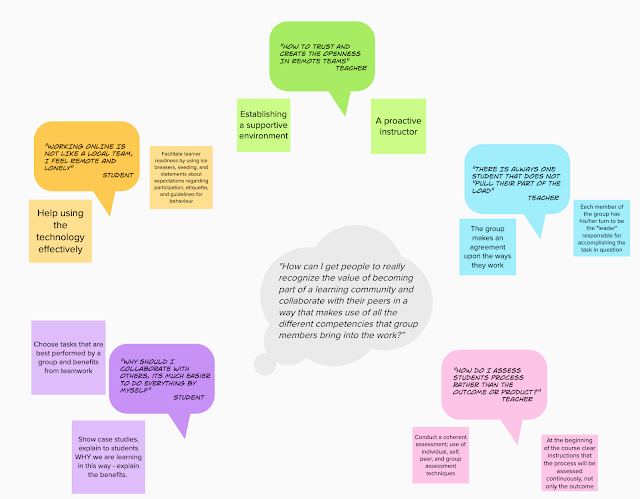 |
| The challenges and mitigations from the teamwork in Team 3 |
I thought that I could use the same framework to describe how I have handled some of these challenges. You can find the Mural here with links to relevant publications.
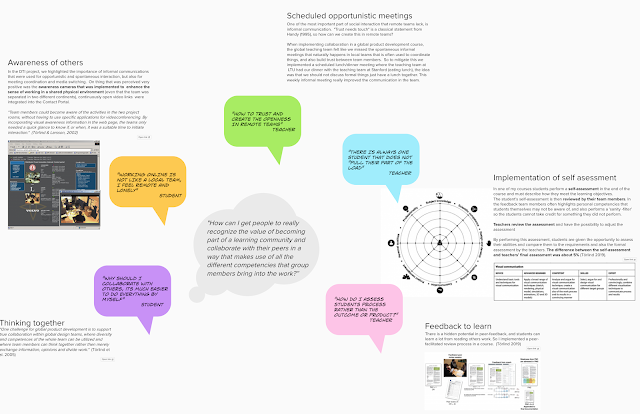 |
| My mitigation strategies for some of the challenges. |
Individual assessment of collaborative work
In one of my courses, students perform a self-assessment at the end of the course and must describe how they meet the learning objectives.
The student’s self-assessment is then reviewed by their team members. In the feedback team members often highlights personal competencies that students themselves may not be aware of, and also performs a ‘sanity -filter’ so the students cannot take credit for something they did not perform.
Teachers review the assessment and have the possibility to adjust the assessment
By performing this assessment, students are given the opportunity to assess their abilities and compare them to the requirements and also the formal assessment by the teachers. The difference between the self-assessment and teachers’ final assessment was about 5% (Törlind 2019).
Trust and openness in distributed teams
One of the most important parts of social interaction that remote teams lack is informal communication. “Trust needs touch” is a classical statement from Handy (1995), so how can we create this in remote teams?
When implementing collaboration in a global product development course, the global teaching team felt like we missed the spontaneous informal meetings that naturally happens in local teams that are often used to coordinate things, and also build trust between team members. So to mitigate this we implemented a scheduled lunch/dinner meeting where the teaching team at LTU had our dinner with the teaching team at Stanford (eating lunch), the idea was that we should not discuss formal things just have lunch together. This weekly informal meeting really improved communication in the team.
Awareness of others
In the DTI project, we highlighted the importance of informal communications that were used for opportunistic and spontaneous interaction, but also for meeting coordination and media switching. One thing that was perceived very positive was the awareness cameras that were implemented to enhance the sense of working in a shared physical environment (even that the team was separated in two different continents), continuously open video links were integrated into the Contact Portal.
“Team members could become aware of the activities in the two project rooms, without having to use specific applications for videoconferencing. By incorporating visual awareness information in the web page, the teams only needed a quick glance to know if, or when, it was a suitable time to initiate interaction.” (Törlind & Larsson, 2002)
Thinking together
“One challenge for global product development is to support true collaboration within global design teams, where diversity and competences of the whole team can be utilized and where team members can think together rather than merely exchange information, opinions and divide work.” (Törlind et al. 2005)