 https://www.gillysalmon.com/five-stage-model.html
Collaborative learning may happen within the online learning community, for example a community of the course or teachers community in the university or, more openly, in a personal online learning tetwork, which an individual learner form out of variouse resources: by following blogs, participating or following the docussions in a profesonals’ and users’ forums,or in variouse social media. While community of learners structured and is organised by an institution and consists of fixed pre-selected participants with a similar level of knowledge and the same goal, online network are formed individually out of trustful resources and personalities in a large amount of information, which is dynamic and searched and validated for the quality of the content and professionalism of other members by the learners themselves driven by own goals. In both ways, collaboration has multiple benefits, offering easy access to common knowledge, it’s fast social construction, opening different perspectives, and an opportunity for personal and professional development through communication.
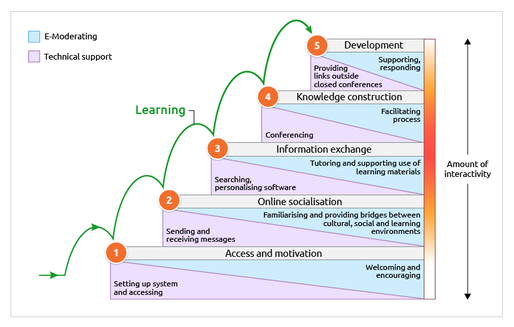
Therefore, it is highly valuable to implement collaborative learning in offline and onlie learning. So, how to successfully implement collaborative learning in your course? Gilly Salmon suggests the wonderful 5-stages framework for collaborative online learning (presented in the illustration) that was used as a model.
Step 1 is organisation of access and increasing motivation. The step can be implemented in a form of an intro video, that presents the course and the teacher, explaining the schedule and structure, assignments and deliverables, and how the course is integrated with the educational programme or is valuable for professional development, as well culture and behaviour in the course.
Course info page should be established.
Step 2, pay attention to the importance of online socialisation, it increases sense of community between the participants of the course and, therefore, enhances collaboration. The work can be planned in small groups. it is beneficial to give learners time and freedom to present themselfes and form these groups, possibly select a case, and get to know each other before the assignment start. Discuss openly course etiquette, guidelines, share expectations about participation.
Possibility for direct mesages, shared group space and opportunity to link in social media is requared.
Step 3 is information exchange through co-creation in small or large groups.
Blogs, Vlogs, Tweets, Collaborative teaching platforms, Meeting rooms, Webinars etc. are ways to facilitate exchage.
Step 4 social knowledge construction through analysis, interpretation, elavulation and synthasis. “Knowledge construction is a collaborative process which aims to produce new understanding or knowledge which exceeds something that anyone alone could not achieve. It is also essential that knowledge construction is based on each others’ ideas and thoughts” (Oksanen, Lainema & Hämäläinen, 2017).
Final 5th step is development, which occur when students are comfortable with collaboration in cooperation, become responsible for their proces and results and bale to self-access the outcomes.
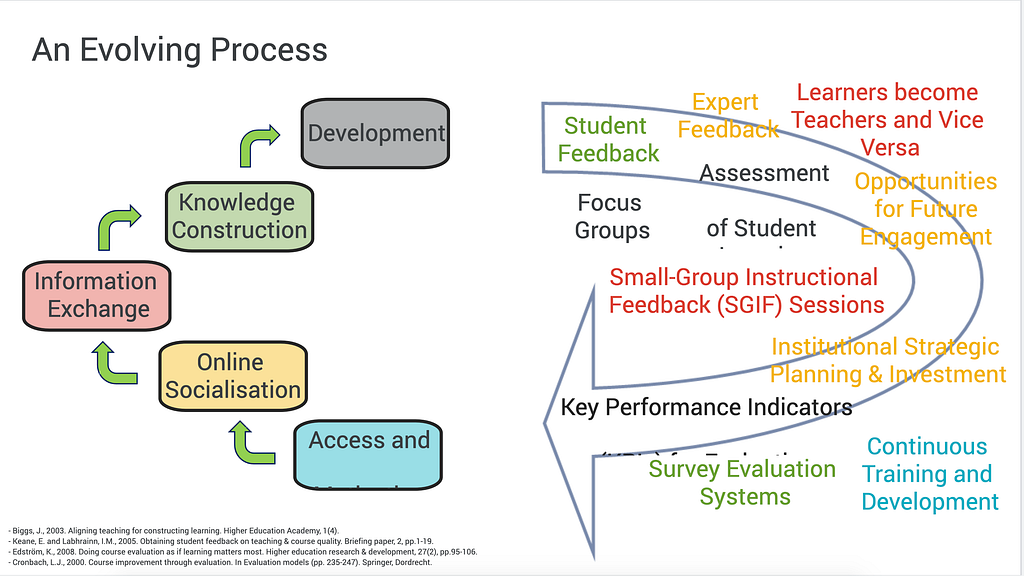
Developments comes through reflection, evaluation, constructive critics and is based on all foure previouse stages.
Resources:
Brindley, J., Blaschke, L. M. & Walti, C. (2009). Creating effective collaborative learning groups in an online environment. The International Review of Research in Open and Distance Learning, 10(3).
Capdeferro, N. & Romero, M. (2012). Are online learners frustrated with collaborative learning experiences?. The International review of research in open and distance learning, 13(2), 26–44.
ONL 2 2020 group 13 work.